

Google Ads for Local Businesses: The Complete Guide for Music Teachers to Get More Students
For music teachers, attracting a steady stream of students is one of the biggest challenges in building a successful teaching business. Whether you teach piano, guitar, violin, drums, vocals, or any other instrument, your ability to reach local students directly impacts your income and long-term growth.
Traditionally, music teachers relied on referrals, flyers, local advertisements, and word-of-mouth marketing. While these methods can still be effective, they often produce inconsistent results and limit your ability to scale.
Today, most parents and aspiring musicians begin their search online. They use Google to find music lessons nearby, compare instructors, read reviews, and book consultations. This is where Google Ads for local businesses becomes a powerful tool.
Google Ads allows music teachers to appear at the top of search results when potential students actively search for lessons in their area. Instead of waiting for referrals, you can put your business in front of people who are already looking for the services you offer.
This guide explains how Google Ads for local businesses works for music teachers, why it is effective, and how you can use it to generate more inquiries, bookings, and long-term students.
Why Music Teachers Need Online Advertising
The music education industry has become increasingly competitive. Independent instructors now compete with:
- Music schools
- Online lesson platforms
- Community centers
- Private academies
- Virtual teaching programs
Many talented instructors struggle to find students simply because they lack visibility online.
When someone searches for: Google ads for local businesses
- Piano lessons near me
- Guitar teacher in my city
- Singing lessons for beginners
- Violin classes nearby
- Drum lessons for kids
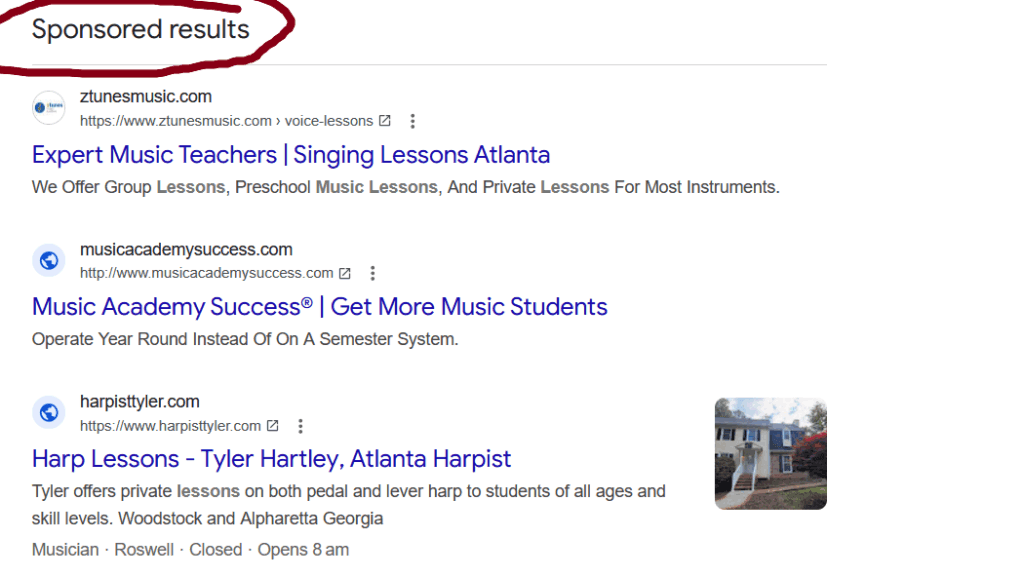
Google displays multiple results. Businesses using Google Ads often appear above organic listings, giving them immediate visibility.
This advantage can significantly increase inquiries and enrollment opportunities.
Understanding Google Ads for Local Businesses
Google Ads for local businesses is a pay-per-click advertising platform that enables businesses to appear in Google Search results, Google Maps, YouTube, and partner websites.
For music teachers, the most valuable placement is usually Google Search.
When a potential student searches for lessons, your ad can appear at the top of the page. You only pay when someone clicks your ad.
For example, if a parent searches:
“Best piano teacher near me”
Your advertisement may appear before other music instructors.
This allows you to connect with highly motivated prospects at the exact moment they are looking for lessons.
Benefits of Google Ads for Music Teachers
Immediate Visibility
Search engine optimization can take months to produce results.
Google Ads can place your teaching business at the top of search results within hours of launching a campaign.
Reach Students Actively Searching
Unlike social media advertising, Google Ads targets people who are already searching for music lessons.
These users have stronger buying intent and are more likely to book lessons.
Local Targeting
Music teachers usually serve a specific geographic area.
Google Ads allows you to target:
- Specific cities
- ZIP codes
- Neighborhoods
- Radius around your location
This ensures your advertising budget reaches relevant prospects.
Budget Flexibility
You do not need a large advertising budget.
Many music teachers start with:
- $5–$20 per day
- $150–$600 per month
Even small budgets can generate valuable leads when campaigns are properly optimized.
Measurable Results
Google Ads provides detailed insights including:
- Clicks
- Calls
- Form submissions
- Website visits
- Conversion rates
This data helps you improve campaign performance over time.
Why Google Ads Works Better Than Traditional Advertising
Many music instructors spend money on:
- Newspaper ads
- Flyers
- Posters
- Community bulletin boards
The problem is that these methods target a broad audience.
Google Ads focuses on users actively looking for music lessons.
For example:
A flyer may be seen by hundreds of people who have no interest in music.
A Google search for “guitar lessons near me” comes from someone already interested in learning guitar.
This difference dramatically improves lead quality.
Setting Up Your Music Teaching Business for Success
Before running ads, ensure your business is prepared to convert visitors into students.
Create a Professional Website
Your website should include:
- Instructor biography
- Teaching experience
- Instruments offered
- Pricing information
- Student testimonials
- Contact information
- Online booking option
A professional website increases trust and conversion rates.
Optimize Your Google Business Profile
A complete Google Business Profile helps local students find your business.
Include:
- Business name
- Address
- Phone number
- Photos
- Reviews
- Service descriptions
This improves local visibility and supports your advertising efforts.
Gather Student Reviews
Positive reviews increase credibility and encourage prospective students to contact you.
Ask satisfied students to leave reviews after successful lessons.
Best Keywords for Music Teachers
Keyword selection is critical for successful Google Ads campaigns.
Target keywords with strong local intent.
Examples include:
Piano Teachers
- Piano lessons near me
- Piano teacher near me
- Piano classes for beginners
- Piano instructor in my city
- Private piano lessons
Guitar Teachers
- Guitar lessons near me
- Guitar teacher nearby
- Acoustic guitar classes
- Electric guitar lessons
- Beginner guitar lessons
Vocal Coaches
- Singing lessons near me
- Voice coach near me
- Vocal training classes
- Singing teacher for beginners
Drum Instructors
- Drum lessons near me
- Drum teacher nearby
- Drum classes for kids
- Private drum lessons
General Keywords
- Music lessons near me
- Music teacher near me
- Private music lessons
- Local music instructor
- Music classes nearby
These keywords align perfectly with Google Ads for local businesses because they target nearby prospects.
Creating High-Converting Ad Copy
Your advertisement must encourage users to click.
A strong ad includes:
Headline Example
Piano Lessons Near You
Alternative Headlines
Experienced Piano Teacher
Book Your First Lesson Today
Private Music Lessons for All Ages
Learn Guitar With Expert Guidance
Description Example
Personalized music lessons for beginners and advanced students. Flexible scheduling. Book your first lesson today.
Effective ads focus on benefits rather than features.
Building Effective Landing Pages
Many advertisers make the mistake of sending traffic to a generic homepage.
Instead, create dedicated landing pages.
For example:
Piano Landing Page
Focus exclusively on piano lessons.
Include:
- Benefits
- Pricing
- Student reviews
- Booking form
Guitar Landing Page
Discuss:
- Guitar programs
- Learning outcomes
- Lesson formats
Dedicated pages improve conversion rates because they match user intent.
Using Call Extensions
Many parents prefer calling directly.
Google Ads allows call extensions that display your phone number alongside your advertisement.
Benefits include:
- More phone inquiries
- Faster communication
- Higher conversion rates
For local businesses, phone calls often produce the highest-quality leads.
Using Location Extensions
Location extensions help potential students find your teaching studio.
Benefits include:
- Increased trust
- Better local visibility
- Improved click-through rates
They also support Google Maps visibility.
Targeting the Right Audience
Parents
Parents often search for music lessons for children.
Use messaging that highlights:
- Structured learning
- Confidence building
- Performance opportunities
Teenagers
Teenagers often seek:
- Guitar lessons
- Vocal coaching
- Drumming instruction
Highlight creativity and skill development.
Adults
Adult learners frequently pursue music as a hobby.
Emphasize:
- Flexible schedules
- Beginner-friendly lessons
- Stress-free learning
Budgeting for Google Ads
Advertising costs vary by location and competition.
A typical music teacher might spend:
Starter Budget
$150–$300 monthly
Suitable for:
- Solo instructors
- Small service areas
Growth Budget
$300–$800 monthly
Suitable for:
- Established teachers
- Multiple lesson programs
Expansion Budget
$800+ monthly
Suitable for:
- Music schools
- Multi-location academies
Start small and scale as results improve.
Tracking Conversions
Without conversion tracking, you cannot accurately measure campaign success.
Track:
- Phone calls
- Contact form submissions
- Trial lesson bookings
- Online registrations
This data reveals which keywords generate actual students.
Common Mistakes Music Teachers Make
Targeting Too Large an Area
Focus on your local market.
Broad targeting often wastes budget.
Using Generic Keywords
Keywords like “music” are too broad.
Use local, lesson-specific keywords instead.
Ignoring Mobile Users
Most searches occur on mobile devices.
Ensure your website loads quickly and displays correctly on smartphones.
Not Following Up Quickly
Lead response time matters.
Contact prospects as soon as possible after receiving an inquiry.
Google Ads Versus Social Media Ads
Many instructors ask whether Google Ads or social media advertising is better.
The answer depends on your goals.
Google Ads
Advantages:
- High buying intent
- Immediate visibility
- Strong local targeting
Social Media Ads
Advantages:
- Brand awareness
- Audience engagement
- Community building
For most music teachers seeking new students quickly, Google Ads for local businesses typically delivers faster lead generation results.
Advanced Strategies for Music Teachers
Remarketing Campaigns
Remarketing targets people who previously visited your website.
This helps bring back interested prospects who did not book immediately.
Seasonal Promotions
Consider campaigns around:
- Back-to-school season
- Summer lessons
- Holiday music programs
Seasonal demand often creates opportunities for increased enrollment.
Video Advertising
Short instructional videos can showcase your teaching style.
Potential students gain confidence before booking lessons.
Competitor Keyword Campaigns
Target searches related to competing music schools.
This strategy can help attract students exploring multiple options.
Measuring Return on Investment
Suppose:
- Monthly ad spend: $300
- New students acquired: 5
- Average monthly revenue per student: $120
Revenue:
5 × $120 = $600 monthly
If those students remain for several months, lifetime revenue grows significantly.
This demonstrates why Google Ads for local businesses can be highly profitable for music teachers.
Long-Term Growth Through Google Ads
The most successful music teachers view advertising as an investment rather than an expense.
Benefits accumulate over time through:
- Increased brand recognition
- More reviews
- Better local visibility
- Growing student base
- Improved referral opportunities
As your reputation grows, each new student contributes to long-term business expansion.
How Music Teachers Can Dominate Local Search Results
To maximize success:
Build a Professional Website
A professional website is the foundation of any successful digital marketing strategy for music teachers. When using Google Ads for local businesses, your website serves as the destination where potential students learn about your teaching experience, lesson offerings, pricing, testimonials, and contact information. A well-designed website builds trust, improves user experience, and increases the likelihood that visitors will book a lesson. Ensure your site is mobile-friendly, loads quickly, and includes clear calls-to-action so visitors can easily contact you or schedule a consultation.
Optimize Your Google Business Profile
Optimizing your Google Business Profile is essential when running Google Ads for local businesses because it improves your visibility in local search results and Google Maps. A complete profile should include your business name, address, phone number, website, business hours, photos, and service descriptions. Music teachers who maintain an updated profile often attract more local inquiries because prospective students can quickly find accurate information and read reviews before making a decision.
Collect Student Reviews
Positive student reviews play a significant role in building credibility and attracting new students. When potential clients see genuine feedback from satisfied students and parents, they are more likely to trust your services. As part of a successful Google Ads for local businesses strategy, consistently collecting reviews can improve both your local rankings and conversion rates. Encourage students to share their experiences after achieving milestones or completing lessons successfully.
Use Highly Targeted Local Keywords
Selecting the right keywords is one of the most important aspects of running effective Google Ads for local businesses. Music teachers should focus on keywords with strong local intent, such as “piano lessons near me,” “guitar teacher in [city],” or “singing classes nearby.” These targeted keywords help your ads reach people actively searching for music lessons in your area, resulting in higher-quality leads and better advertising performance.
Create Dedicated Landing Pages
Dedicated landing pages improve the effectiveness of your advertising campaigns by providing visitors with information that directly matches their search intent. Instead of sending all traffic to your homepage, create separate pages for piano lessons, guitar lessons, vocal coaching, or other services. When combined with Google Ads for local businesses, dedicated landing pages can significantly increase conversion rates because visitors immediately find the information they are looking for.
Track Conversions Accurately
Tracking conversions allows music teachers to understand which advertising efforts are generating actual inquiries and student enrollments. By monitoring phone calls, contact form submissions, lesson bookings, and consultation requests, you can measure the true effectiveness of your Google Ads for local businesses campaigns. Accurate conversion tracking helps eliminate guesswork and enables smarter budget allocation based on real performance data.
Optimize Campaigns Regularly
Google Ads is not a set-it-and-forget-it platform. To achieve the best results, music teachers should regularly review campaign performance and make adjustments as needed. This includes refining keywords, updating ad copy, adjusting bids, and improving landing pages. Ongoing optimization ensures your Google Ads for local businesses campaigns remain competitive, cost-effective, and capable of generating consistent student inquiries over time.
Follow Up With Leads Quickly
Speed matters when responding to prospective students. Many people contact multiple music teachers before making a decision, so responding quickly can significantly improve your chances of securing a new student. As part of your Google Ads for local businesses strategy, establish a system for promptly answering calls, emails, and contact form inquiries. Fast follow-up demonstrates professionalism and increases conversion rates.
Test Different Ad Variations
Testing multiple versions of your advertisements helps identify which messages resonate most with potential students. Experiment with different headlines, descriptions, offers, and calls-to-action to determine what generates the highest click-through and conversion rates. Successful Google Ads for local businesses campaigns rely on continuous testing because even small changes can lead to significant improvements in performance.
Increase Budgets on Profitable Campaigns
Once you identify campaigns that consistently generate student enrollments at a profitable cost, consider increasing your advertising budget. Scaling successful campaigns allows you to attract more students while maintaining a positive return on investment. For music teachers using Google Ads for local businesses, increasing budgets on proven campaigns is often the fastest way to accelerate growth and build a thriving teaching business.
- Build a professional website.
- Optimize your Google Business Profile.
- Collect student reviews.
- Use highly targeted local keywords.
- Create dedicated landing pages.
- Track conversions accurately.
- Optimize campaigns regularly.
- Follow up with leads quickly.
- Test different ad variations.
- Increase budgets on profitable campaigns.
Following these steps can help music teachers consistently attract new students and establish themselves as trusted instructors in their local market.
Conclusion
The music teaching industry continues to evolve, and online visibility has become essential for attracting new students. While referrals and word-of-mouth remain valuable, they often fail to provide predictable growth.
Google Ads for local businesses offers music teachers a powerful way to reach prospective students exactly when they are searching for lessons. By targeting local keywords, creating compelling advertisements, optimizing landing pages, and tracking results, instructors can generate a steady stream of qualified leads.
Whether you teach piano, guitar, vocals, drums, violin, or multiple instruments, a well-structured Google Ads campaign can help you fill your schedule, increase revenue, and grow a thriving music education business. The key is to focus on local intent, provide an excellent user experience, and continuously optimize your campaigns for better performance.
Also Read:
Google Ads for Small Businesses: Complete Guide for Veterinary Clinics and VET Doctors
Frequently Asked Questions (FAQ)
What is Google Ads for local businesses and how does it help music teachers?
Google Ads for local businesses is an online advertising platform that allows music teachers to display their services at the top of Google search results when people search for lessons in a specific area. For example, if a parent searches for “piano lessons near me” or “guitar teacher nearby,” a properly optimized Google Ads campaign can place your business in front of that potential student immediately. This targeted visibility helps music teachers generate more inquiries, increase lesson bookings, and grow their student base without relying solely on referrals or traditional advertising methods.
How much should a music teacher spend on Google Ads each month?
The ideal budget depends on your location, competition, and enrollment goals. Many independent music teachers begin with a budget between $150 and $300 per month to test keyword performance and lead quality. As campaigns become profitable, instructors often increase spending to $500 or more per month. The important factor is not the budget size itself but whether the campaign generates students at a cost that produces a positive return on investment.
Which keywords are best for music teachers using Google Ads?
The most effective keywords usually include strong local intent and specific lesson types. Examples include “piano lessons near me,” “guitar teacher in my city,” “singing lessons for beginners,” “private drum lessons,” and “music teacher nearby.” These keywords work well because they target people actively searching for instruction. Broad terms such as “music” or “songs” often attract irrelevant traffic and should generally be avoided.
Do music teachers need a website before running Google Ads?
Yes, having a professional website is strongly recommended. A website serves as the destination where potential students learn about your teaching experience, lesson offerings, pricing, testimonials, and contact information. Without a quality website or landing page, many advertising clicks may not convert into inquiries. An optimized website significantly improves campaign performance and helps establish credibility with prospective students.
How long does it take to see results from Google Ads?
Many music teachers begin receiving clicks, calls, and inquiries within days of launching a campaign. Unlike search engine optimization, which may take months to generate visibility, Google Ads can produce immediate exposure. However, campaign optimization is an ongoing process. Most instructors see stronger and more consistent results after several weeks of testing keywords, ad copy, landing pages, and audience targeting.
Is Google Ads better than social media advertising for music teachers?
Both platforms can be valuable, but they serve different purposes. Google Ads targets people actively searching for music lessons, making it highly effective for generating immediate leads. Social media advertising is often better suited for brand awareness, audience engagement, and community building. For music teachers whose primary goal is attracting new students quickly, Google Ads for local businesses is usually the more direct and results-driven option.
Can music teachers advertise online lessons with Google Ads?
Absolutely. Music teachers offering virtual lessons can use Google Ads to reach students beyond their immediate geographic area. Campaigns can target broader regions, states, or even entire countries depending on the lesson format and language. Online lesson providers often combine local campaigns with virtual lesson campaigns to maximize enrollment opportunities and create multiple revenue streams.
Ready to take your music business to the next level? Don’t wait for customers to find you—let a certified Google Ads expert create a tailored advertising strategy that drives calls, bookings, and real results. Click the button below to book your appointment now and start generating high-quality leads today
