
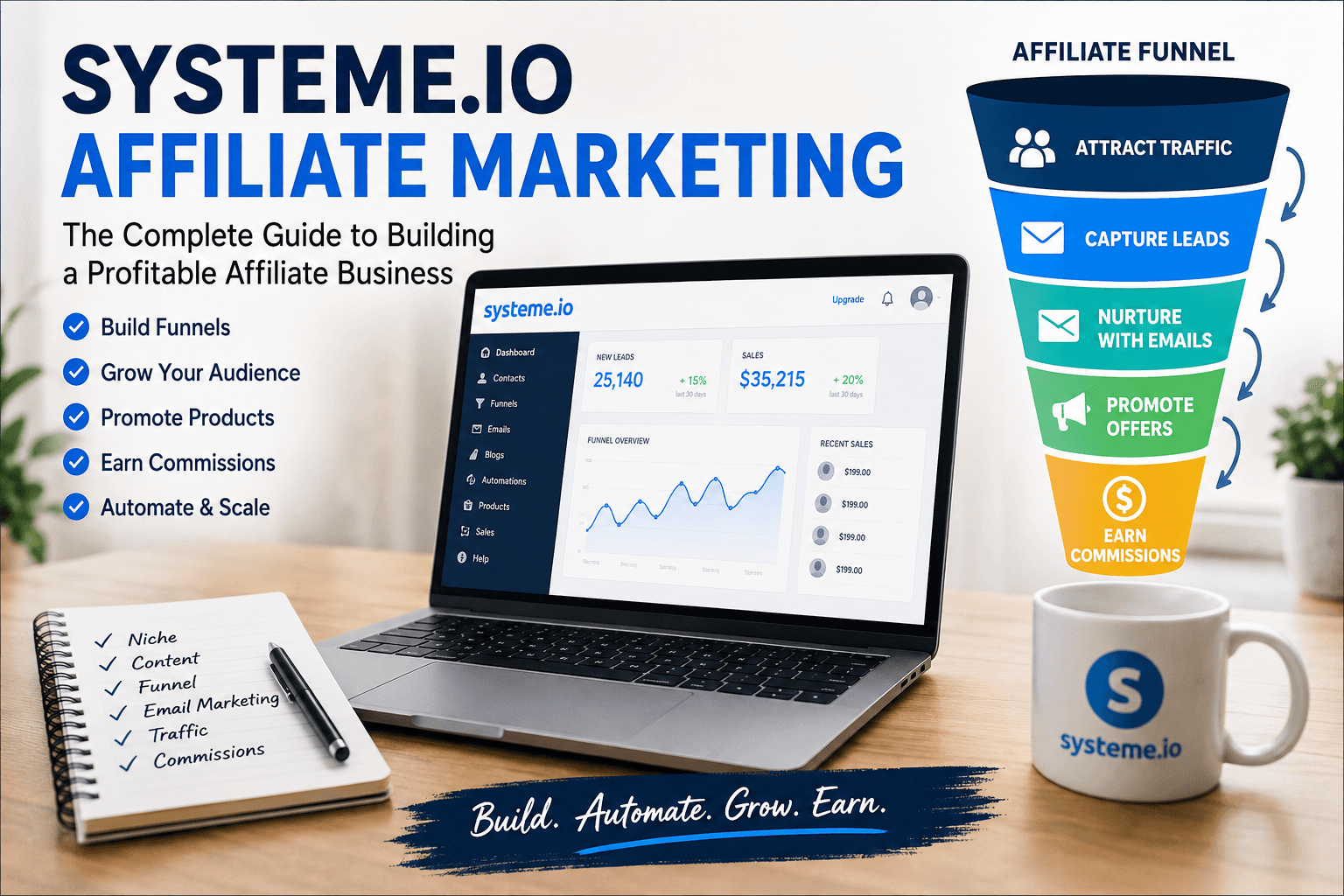

Systeme.io Affiliate Marketing: The Complete Guide to Building a Profitable Affiliate Businesshas become one of the most accessible ways to build an online business without creating your own products, managing inventory, or handling complicated customer fulfillment. However, success in affiliate marketing depends on more than simply placing affiliate links on a website and waiting for commissions.
You need a system that can capture leads, educate prospects, build trust, promote relevant offers, and measure your results.
This is where Systeme.io affiliate marketing becomes particularly interesting.
Systeme.io is an all-in-one online business platform that combines tools such as sales funnels, landing pages, email marketing, automation, websites, courses, and other business features in one environment. For affiliate marketers, this type of platform can simplify the process of creating the infrastructure required to turn visitors into subscribers and subscribers into customers.
In this comprehensive guide, you’ll learn what Systeme.io affiliate marketing is, how the business model works, how to create an affiliate funnel, how to generate traffic, how to use email marketing, the advantages and disadvantages of the strategy, common mistakes to avoid, and practical steps for building a long-term affiliate marketing business.
What Is Systeme.io Affiliate Marketing?
Systeme.io affiliate marketing refers to using Systeme.io’s marketing and business tools to build, manage, and grow an affiliate marketing business.
At its simplest, affiliate marketing works like this:Systeme.io Affiliate Marketing
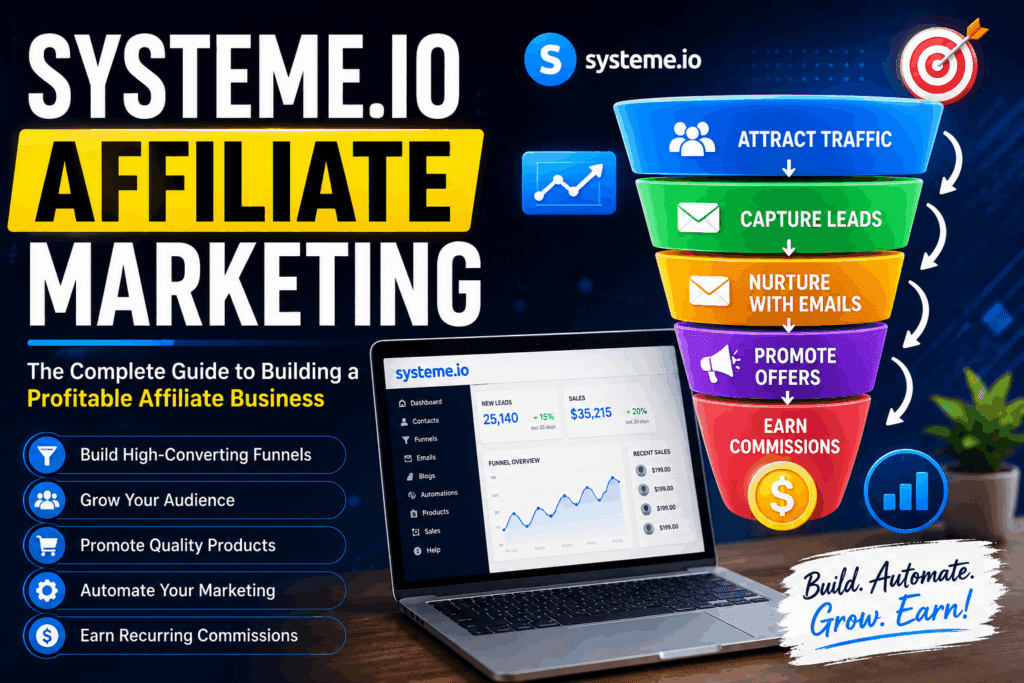
Traffic → Landing Page → Lead → Email Follow-Up → Affiliate Offer → Commission
You promote a product or service belonging to another company. When someone clicks your unique affiliate link and completes a qualifying action—usually making a purchase—you receive a commission according to the affiliate program’s terms.
Systeme.io can provide many of the tools needed to build the marketing system around that affiliate offer.
For example, you can use a funnel to:
- Attract visitors.
- Offer a free lead magnet.
- Collect email addresses.
- Send automated emails.
- Educate subscribers.
- Recommend relevant products.
- Send qualified prospects to the merchant.
- Measure funnel performance.
The important point is that Systeme.io itself isn’t a substitute for an affiliate strategy. It is the infrastructure that can help you execute that strategy.
How Does Systeme.io Affiliate Marketing Work?
A successful affiliate marketing funnel typically consists of several connected stages.
Step 1: Choose a Niche
Start with a specific niche instead of trying to promote everything to everyone.
Potential niches include:
- Digital marketing
- Freelancing
- Graphic design
- Website development
- Software and SaaS
- Online education
- Productivity
- Personal finance
- Fitness
- Business tools
- Email marketing
- Content creation
Your niche should ideally have three characteristics:
Demand: People actively search for information and solutions.
Commercial potential: Products or services exist that you can legitimately recommend.
Personal interest or expertise: You can create useful content consistently.
Choosing a niche only because you believe it will make money can make content creation difficult. A niche where you can consistently provide useful information is usually more sustainable.
Step 2: Find Relevant Affiliate Programs
After selecting your niche, research affiliate programs that offer products your audience could genuinely benefit from.
Look for programs based on:
- Product quality
- Commission structure
- Cookie duration
- Recurring commissions
- Affiliate support
- Payment terms
- Brand reputation
- Conversion rates
- Promotional restrictions
Don’t choose an affiliate product solely because it has a high commission.
A product that pays $100 but rarely converts may be less valuable than a product that pays $20 and converts consistently.
Your primary objective should be to recommend products that solve real problems for your audience.
Step 3: Create a Lead Magnet
One of the biggest mistakes beginner affiliate marketers make is sending every visitor directly to an affiliate offer.
Instead, consider building your own audience.
A lead magnet is a free resource offered in exchange for a visitor’s email address.
Examples include:
- Free PDF guide
- Checklist
- Ebook
- Template
- Resource list
- Mini-course
- Tutorial
- Case study
- Spreadsheet
- Free consultation
- Webinar
For example, if your niche is freelancing, you could create:
“50 Freelancing Tools Every Beginner Should Know”
A visitor enters their email address to receive the resource. You can then continue providing valuable information through email.
This creates an asset you control: your email audience.
Building a Systeme.io Affiliate Funnel
A funnel is one of the most important components of a Systeme.io affiliate marketing strategy.
A simple funnel could look like this:
Traffic Source
↓
Landing Page
↓
Lead Magnet
↓
Thank-You Page
↓
Email Sequence
↓
Educational Content
↓
Affiliate Recommendation
↓
Merchant Website
Let’s examine each stage.
1. Traffic Source
Traffic can come from several channels.
Organic Search
Create helpful blog posts targeting questions people search for.
For example:
- Best email marketing tools for beginners
- How to create a sales funnel
- Best landing page tools
- Systeme.io alternatives
- Best tools for freelancers
- How to start affiliate marketing
SEO can take time, but successful content can continue generating visitors after publication.
YouTube
YouTube is another powerful channel for affiliate marketing.
You can create:
- Tutorials
- Product reviews
- Comparisons
- Case studies
- How-to videos
- Beginner guides
- Tool demonstrations
For example:
“How to Create a Sales Funnel for Affiliate Marketing”
At the end of the video, you can direct viewers toward a relevant landing page or resource.
Social Media
Social platforms can help distribute content and build relationships with potential customers.
You can publish:
- Short tutorials
- Educational posts
- Carousel content
- Reels
- Case studies
- Tips
- Industry insights
Avoid turning every post into an advertisement. Educational content generally provides more opportunities to build trust.
Paid Advertising
Paid traffic can accelerate testing, but it requires careful budgeting and compliance with both advertising policies and affiliate-program rules.
Before spending money, understand:
- Cost per click
- Conversion rate
- Cost per lead
- Customer acquisition cost
- Affiliate commission
- Return on ad spend
Never assume that more traffic automatically means more profit.
2. Create a High-Converting Landing Page
The landing page has one primary objective.
That objective could be:
- Collecting an email address
- Downloading a resource
- Registering for a webinar
- Booking a call
- Starting a free trial
Keep the page focused.
A basic affiliate lead-generation landing page can include:
Headline
Clearly communicate the benefit.
Example:
“Learn How to Build Your First Profitable Affiliate Funnel—Step by Step”
Supporting Copy
Explain what the visitor will learn and why the resource is useful.
Benefits
Show specific outcomes rather than generic claims.
For example:
- Discover how affiliate funnels work.
- Learn how to capture leads.
- Build an automated email sequence.
- Understand affiliate tracking.
- Avoid common beginner mistakes.
Call-to-Action
Use a clear CTA such as:
“Get the Free Guide”
The goal isn’t to make the landing page complicated. The goal is to remove unnecessary distractions.
3. Create a Thank-You Page
After someone submits their email address, send them to a thank-you page.
This page can:
- Confirm their signup.
- Explain what happens next.
- Provide the promised resource.
- Introduce your next step.
- Recommend relevant content.
- Invite them to follow your social channels.
You can also use the page to begin educating the visitor about the solution you’re promoting.
4. Build an Email Sequence
Email marketing can become one of the most valuable components of your affiliate business.
Instead of sending promotional emails every day, use a combination of:
- Education
- Storytelling
- Tutorials
- Case studies
- Helpful resources
- Product recommendations
For example, a seven-day sequence could look like this:
Day 1: Deliver the Lead Magnet
Welcome the subscriber and provide the promised resource.
Day 2: Identify the Problem
Explain a common problem faced by your audience.
Day 3: Teach a Solution
Provide actionable advice.
Day 4: Share a Case Study
Show how a particular strategy or tool can solve the problem.
Day 5: Introduce a Relevant Product
Explain why the product may be useful.
Day 6: Address Objections
Answer common concerns.
Day 7: Final Recommendation
Provide a clear summary and invitation to explore the offer.
The exact sequence should depend on your audience and the product you’re promoting.
Systeme.io Affiliate Marketing Automation
Automation is one of the biggest reasons marketers use all-in-one funnel platforms.
Instead of manually sending every email, you can create automated workflows.
A basic automation might look like:
Visitor submits form
↓
Add subscriber to email campaign
↓
Send welcome email
↓
Wait 1 day
↓
Send educational email
↓
Wait 1 day
↓
Send case study
↓
Send product recommendation
↓
Continue nurturing
This allows your marketing system to operate even when you’re not actively working on it.
However, automation should not mean sending irrelevant messages.
Good automation should make communication more relevant, not simply more frequent.
How to Promote Systeme.io as an Affiliate
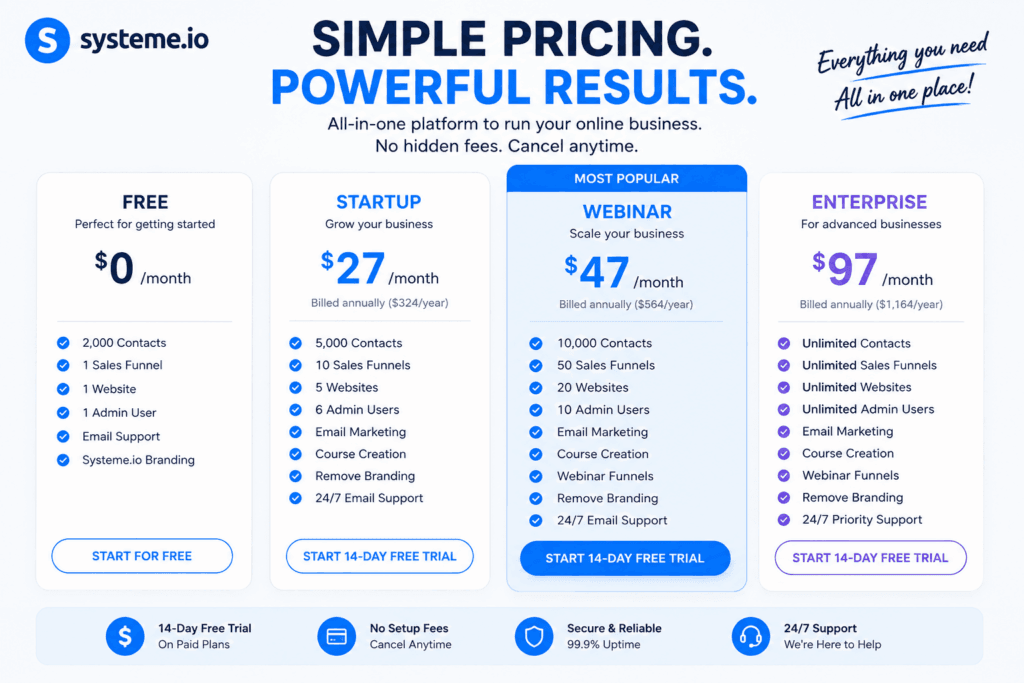
If your goal specifically includes promoting Systeme.io through its affiliate program, your marketing approach should focus on helping people understand the platform and whether it fits their needs.
Instead of repeatedly saying:
“Buy Systeme.io.”
Create useful content around problems the platform can solve.
Examples include:
- How to create a sales funnel
- How to build an email list
- How to create a landing page
- How to automate email marketing
- How to create an online course
- How to build a simple sales funnel
- Systeme.io review
- Systeme.io tutorial
- Systeme.io vs other funnel platforms
- Systeme.io for beginners
This approach attracts people who are already interested in the underlying problem.
Content Marketing Strategy for Systeme.io Affiliate Marketing
Content marketing can provide a strong foundation for long-term affiliate growth.
Create content around different stages of the buyer journey.
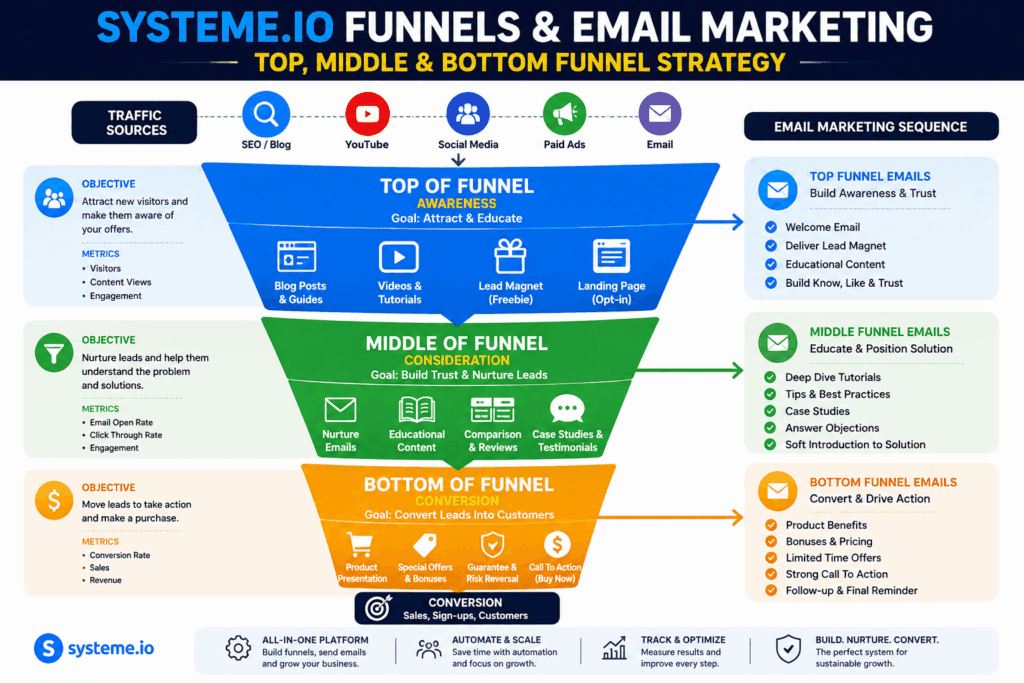
Top-of-Funnel Content
These articles attract people who are researching a topic.
Examples:
- What is affiliate marketing?
- What is a sales funnel?
- What is email marketing?
- How does lead generation work?
- How do landing pages work?
These visitors may not be ready to purchase anything.
Your objective is to educate them.
Middle-of-Funnel Content
These visitors are evaluating potential solutions.
Examples:
- Best sales funnel platforms
- Best email marketing software
- Systeme.io alternatives
- Landing page software comparison
- Best tools for affiliate marketers
These topics often have stronger commercial intent.
Bottom-of-Funnel Content
These visitors are close to making a decision.
Examples:
- Systeme.io review
- Systeme.io pricing guide
- Systeme.io tutorial
- Systeme.io vs [competitor]
- Is Systeme.io worth it?
- Systeme.io for affiliate marketing
This type of content can be particularly valuable because readers are actively evaluating a product.
SEO Strategy for Systeme.io Affiliate Marketing
If you want to generate organic traffic, don’t focus only on one keyword.
Build a keyword cluster around your primary topic.
Your main keyword might be:
Systeme.io affiliate marketing
Supporting keywords could include:
- Systeme.io affiliate program
- Systeme.io affiliate marketing tutorial
- how to use Systeme.io for affiliate marketing
- Systeme.io affiliate funnel
- Systeme.io affiliate marketing strategy
- Systeme.io affiliate marketing for beginners
- how to promote Systeme.io
- Systeme.io affiliate commission
- Systeme.io funnel for affiliates
- affiliate marketing funnel with Systeme.io
Use keywords naturally.
Avoid keyword stuffing.
Search engines increasingly reward content that demonstrates genuine usefulness and satisfies the reader’s intent.
How to Create a Blog Strategy
A good affiliate website shouldn’t consist entirely of product reviews.
Create different content categories.
Educational Content
Teach your audience fundamental concepts.
Tutorial Content
Show people exactly how to accomplish something.
Comparison Content
Help users compare competing solutions.
Review Content
Evaluate products honestly.
Case Studies
Demonstrate real processes and outcomes.
Resource Content
Create lists of useful tools, templates, and resources.
A diversified content strategy can help your website attract visitors at different stages of the buying journey.
Pros and Cons of Systeme.io Affiliate Marketing
Pros
1. All-in-One Approach
Using one platform for multiple marketing tasks can simplify your technology stack.
2. Funnel Creation
You can build landing pages and sales funnels without needing to assemble many separate tools.
3. Email Marketing
Email functionality can help you build and nurture your subscriber base.
4. Automation
Automated workflows can reduce repetitive marketing tasks.
5. Beginner-Friendly Business Model
Affiliate marketing doesn’t require you to manufacture your own product.
6. Multiple Traffic Opportunities
You can combine SEO, YouTube, social media, email marketing, and other traffic sources.
7. Scalable Content Strategy
A successful article or video can potentially attract visitors repeatedly.
8. Low Initial Product Development Requirements
Because you’re promoting existing products, you don’t need to develop the product yourself.
Cons
1. Affiliate Income Isn’t Guaranteed
Having an affiliate link doesn’t guarantee commissions.
2. Competition Can Be High
Popular affiliate keywords can have significant competition.
3. Traffic Takes Time
Organic SEO can require months of consistent work before producing meaningful results.
4. Platform Dependency
If your business relies heavily on one platform, changes to pricing, features, policies, or affiliate terms can affect your strategy.
5. Trust Is Difficult to Build
Audiences quickly lose confidence when every piece of content feels like a sales pitch.
6. Requires Consistent Content
Successful affiliate businesses usually require ongoing publishing and optimization.
7. Compliance Matters
Affiliate marketers need to follow applicable advertising, disclosure, privacy, email marketing, and platform rules.
Common Systeme.io Affiliate Marketing Mistakes
Mistake 1: Promoting Too Many Products
Promoting dozens of unrelated products can confuse your audience.
Choose products that fit your niche.
Mistake 2: Sending Traffic Directly to Affiliate Links
You may lose the opportunity to build an email audience.
Where appropriate and permitted, use a lead-generation funnel first.
Mistake 3: Publishing Thin Content
A 500-word article with generic information rarely provides enough value for competitive topics.
Focus on depth, originality, examples, and practical guidance.
Mistake 4: Ignoring SEO
Great content still needs to be discoverable.
Optimize:
- Title
- URL
- Headings
- Internal links
- Search intent
- Metadata
- Content structure
Mistake 5: Making Unrealistic Income Claims
Avoid statements such as:
“Make $10,000 in your first month guaranteed.”
Affiliate results vary considerably.
Focus on the process rather than promising a specific income.
Mistake 6: Ignoring Email Subscribers
Building a list without nurturing it wastes much of its potential.
Provide useful information consistently.
Mistake 7: Not Tracking Results
You need to understand what’s working.
Monitor metrics such as:
- Visitors
- Landing-page conversion rate
- Email opt-in rate
- Email open rate
- Click-through rate
- Affiliate clicks
- Conversion rate
- Earnings per click
- Revenue
- Cost per acquisition
How Much Can You Make With Systeme.io Affiliate Marketing?
There is no universal income figure.
Affiliate earnings depend on factors such as:
- Traffic volume
- Traffic quality
- Audience trust
- Product price
- Commission structure
- Conversion rate
- Email-list size
- Content quality
- SEO performance
- Promotional strategy
- Consistency
For example, imagine a hypothetical funnel receives 10,000 visitors.
If 20% become leads:
10,000 × 20% = 2,000 leads
If 5% of those leads eventually purchase an offer:
2,000 × 5% = 100 customers
If the average affiliate commission were $30:
100 × $30 = $3,000
This is only an illustration, not an income guarantee.
Actual performance can be dramatically different.
The most useful way to think about affiliate marketing is as a numbers-based funnel where you continuously improve each stage.
How to Track Your Affiliate Funnel
Tracking is essential if you want to make informed decisions.
Suppose you have:
1,000 visitors → 250 leads → 50 affiliate clicks → 5 sales
You can calculate:
Lead Conversion Rate
250 ÷ 1,000 = 25%
Affiliate Click Rate
50 ÷ 250 = 20%
Sales Conversion Rate
5 ÷ 50 = 10%
Now you can identify bottlenecks.
If your landing page converts poorly, improve the landing page.
If you generate many leads but few affiliate clicks, improve your email sequence or offer positioning.
If you get many affiliate clicks but few purchases, investigate the offer, audience fit, and traffic quality.
Building Trust With Affiliate Content
Trust is one of the most valuable assets in affiliate marketing.
Here are some ways to build it:
Be Honest
Discuss limitations as well as benefits.
Demonstrate Products
Screenshots, tutorials, walkthroughs, and real examples can make content more useful.
Avoid Fake Reviews
Don’t claim to have personally used something if you haven’t.
Disclose Affiliate Relationships
Tell readers when you may earn a commission from qualifying purchases.
Put the Audience First
Ask:
“Would I recommend this product if I didn’t receive a commission?”
If the answer is no, reconsider promoting it.
A 90-Day Systeme.io Affiliate Marketing Plan
If you’re starting from scratch, avoid trying to build everything in one day.
Days 1–30: Foundation
Focus on:
- Choose your niche.
- Research your target audience.
- Identify relevant affiliate products.
- Create your website or content hub.
- Build your first landing page.
- Create a lead magnet.
- Set up your email sequence.
- Create your first 5–10 content pieces.
Your objective is to establish the foundation.
Days 31–60: Content and Traffic
Focus on:
- Publishing consistently.
- Creating SEO-focused articles.
- Producing YouTube videos.
- Sharing educational social content.
- Improving your landing page.
- Building internal links.
- Growing your email list.
- Testing different calls-to-action.
Your objective is to increase qualified traffic.
Days 61–90: Optimization
Now analyze your data.
Identify:
- Best-performing content
- Highest-converting landing pages
- Most engaged email topics
- Best affiliate offers
- Highest-quality traffic sources
- Weakest funnel stages
Then improve what already works.
Instead of creating ten new projects, double down on the strategies producing the strongest signals.
Systeme.io Affiliate Marketing vs Traditional Affiliate Marketing
Traditional affiliate marketing can involve many separate tools.
For example:
Website + Landing Page Builder + Email Software + Automation Tool + Analytics + Course Platform
An all-in-one platform can potentially reduce the number of systems you need to manage.
This doesn’t automatically make one approach better than another.
Experienced marketers may prefer specialized tools because they offer advanced features.
Beginners, however, may value simplicity and having fewer platforms to configure.
The right choice depends on your business model, technical requirements, budget, and growth stage.
Is Systeme.io Good for Affiliate Marketing?
Systeme.io can be useful for affiliate marketers who want to combine landing pages, funnels, email marketing, and automation within a single platform.
Its biggest potential advantage is simplicity.
Instead of spending significant time connecting multiple systems, you can focus more of your effort on:
Content → Traffic → Leads → Relationships → Conversions
However, the platform alone will not create a successful affiliate business.
Your results ultimately depend on the quality of your strategy, content, traffic, offer selection, audience targeting, and execution.
Best Practices for Systeme.io Affiliate Marketing
Here are some practical principles to follow:
- Choose one niche initially.
- Understand your audience’s problems.
- Promote relevant products.
- Build an email list.
- Create useful content consistently.
- Use funnels to organize your customer journey.
- Automate repetitive tasks.
- Track conversions.
- Test headlines and CTAs.
- Disclose affiliate relationships.
- Avoid unrealistic income claims.
- Focus on long-term trust.
The goal isn’t simply to generate one commission.
The goal is to build a repeatable marketing system.
Final Thoughts
Systeme.io affiliate marketing can be an effective approach for entrepreneurs, content creators, freelancers, and marketers who want to build an affiliate business using funnels, landing pages, email marketing, and automation.
The technology is only one part of the equation.
The real opportunity comes from combining the platform with a well-defined niche, valuable content, targeted traffic, effective lead generation, thoughtful email marketing, and trustworthy product recommendations.
A simple strategy can be:
Choose a niche → Create valuable content → Capture leads → Nurture your audience → Recommend relevant products → Track results → Optimize continuously.
Don’t focus exclusively on quick commissions.
Build an audience.
Build trust.
Build useful content.
Build a funnel.
Then improve the system based on real data.
That’s the foundation of a more sustainable affiliate marketing business.
Frequently Asked Questions
1. What is Systeme.io affiliate marketing?
Systeme.io affiliate marketing involves using Systeme.io’s funnel, landing-page, email marketing, and automation capabilities to support an affiliate marketing business.
2. Can beginners start Systeme.io affiliate marketing?
Yes. Beginners can start by choosing a niche, joining relevant affiliate programs, creating useful content, building a landing page, collecting leads, and developing an email marketing strategy.
3. Do I need a website for affiliate marketing?
Not necessarily. You can use platforms such as YouTube and social media to generate traffic. However, having your own website or content hub can provide additional opportunities for SEO and audience building.
4. Is affiliate marketing free to start?
You can begin with relatively low costs, but building a serious business may require spending on domains, content creation, advertising, software, or other resources.
5. How does a Systeme.io affiliate funnel work?
A typical funnel attracts visitors, collects leads, delivers useful content, nurtures subscribers through email, and eventually recommends a relevant affiliate product.
6. Can I use SEO for Systeme.io affiliate marketing?
Yes. SEO can be used to attract people searching for tutorials, reviews, comparisons, and educational information related to your niche and affiliate products.
7. Is Systeme.io enough to become successful at affiliate marketing?
No platform guarantees success. Systeme.io can provide useful marketing infrastructure, but success depends on your niche, content, traffic, audience, offers, funnel, and execution.
8. How long does affiliate marketing take to make money?
There is no fixed timeline. Some marketers generate commissions quickly, while others need months or longer to build meaningful traffic and an audience.
9. Should I promote multiple affiliate products?
You can, but relevance matters more than quantity. Start with a small number of products that genuinely fit your audience.
10. How do I increase affiliate conversions?
Improve the entire funnel rather than focusing only on the affiliate link. Improve traffic quality, landing-page messaging, lead magnets, email sequences, product selection, calls-to-action, and audience trust.
11. Is email marketing important for affiliate marketing?
Yes. Email allows you to continue communicating with people who have already shown interest instead of relying entirely on one-time website visitors.
12. What is the biggest mistake beginners make?
One of the biggest mistakes is focusing on selling before building trust. Affiliate marketing works better when you first provide useful information and then recommend products that genuinely solve your audience’s problems.
Also Read: Google ads for small businesses
How AdWords Helped a New Jersey Packers & Movers Company Generate Massive Leads
The Roofer’s Blueprint to Dominating Local Search: Mastering Google PPC Ads, Call & GMB Ads
Conclusion
Systeme.io affiliate marketing isn’t a magic shortcut to online income. It is a framework that can help you build the marketing infrastructure behind an affiliate business.
If you combine high-quality content, targeted traffic, lead generation, email automation, relevant affiliate offers, transparent recommendations, and continuous optimization, you can create a much more structured approach to affiliate marketing.
Start small, measure everything, learn from your audience, and improve your funnel over time.
The objective isn’t simply to get clicks. The objective is to create a system that consistently delivers value and turns the right visitors into long-term customers and leads. For more details
