
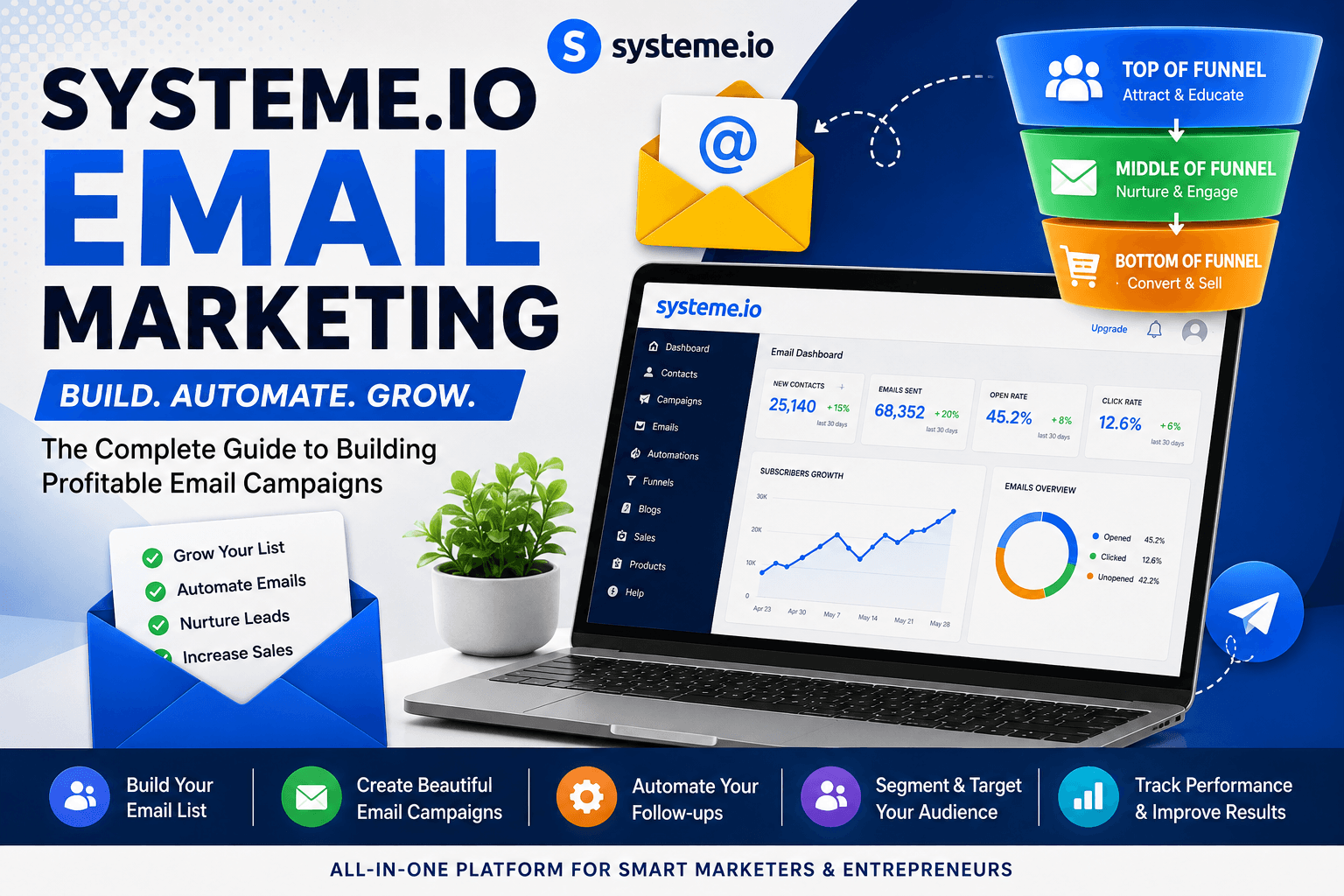

Systeme.io Email Marketing: The Complete Beginner-to-Advanced Guide
Email marketing remains one of the most powerful channels for building relationships with an online audience. Whether you’re an affiliate marketer, freelancer, coach, consultant, course creator, agency owner, blogger, or ecommerce entrepreneur, having direct communication with your audience can give you more control over your marketing.
But effective email marketing involves much more than sending occasional promotional messages.
You need landing pages to capture subscribers, forms to collect information, email campaigns to nurture leads, automation to deliver messages at the right time, segmentation to personalize communication, and analytics to understand what’s working.
This is where Systeme.io email marketing can become useful.
Systeme.io is designed as an all-in-one online business platform that brings together marketing functions such as sales funnels, landing pages, email marketing, automation, websites, online courses, and other business tools. Instead of connecting numerous independent services, marketers can use one environment to build and manage significant parts of their customer journey.
In this comprehensive guide, we’ll explore Systeme.io email marketing, how it works, how to build an email marketing system, how to create campaigns and automations, how to grow your list, how to improve conversions, the pros and cons, common mistakes, and practical strategies for building a sustainable email marketing business.
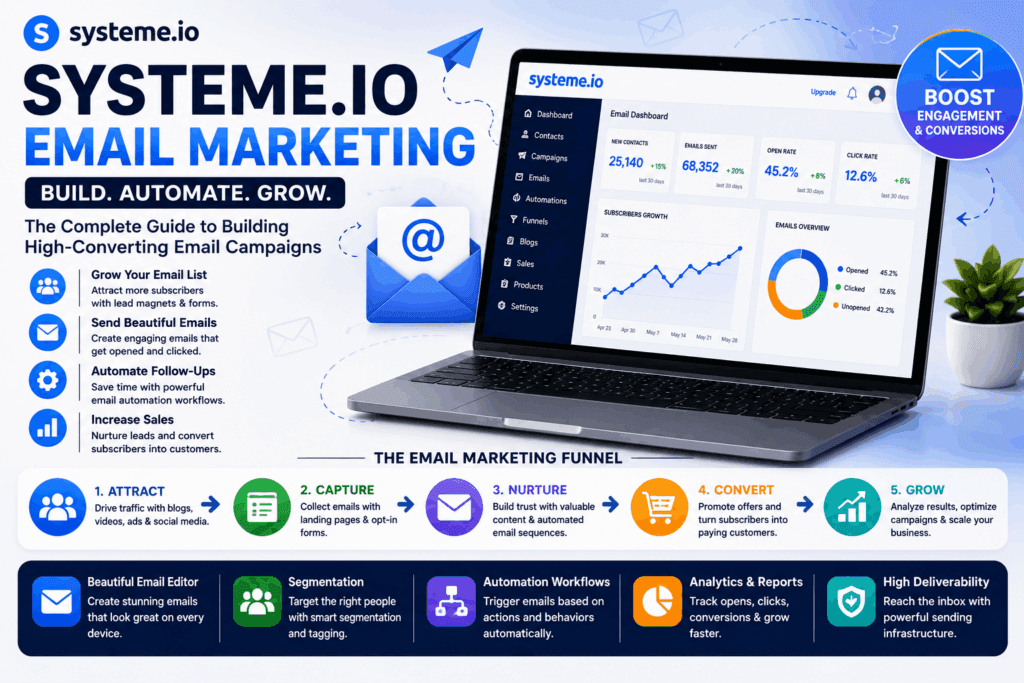
What Is Systeme.io Email Marketing?
Systeme.io email marketing is the use of Systeme.io’s email and automation capabilities to communicate with prospects and customers throughout their buying journey.
A basic email marketing system looks like this:
Visitor → Landing Page → Opt-In Form → Email List → Automated Emails → Offer → Customer
For example, imagine you publish a blog post titled:
“10 Best Tools for Freelancers”
A visitor discovers your article through Google.
At the end of the article, you offer a free resource:
“Download the Ultimate Freelancing Tools Checklist.”
The visitor enters their email address.
They are then added to your email list and receive a welcome message. Over the following days, you can send educational content, tutorials, case studies, helpful resources, and relevant product recommendations.
This creates an ongoing relationship rather than relying on a single website visit.
Why Is Email Marketing Important?
Social media algorithms can change.
Search rankings can fluctuate.
Advertising costs can increase.
But an email list gives you a direct communication channel with people who have voluntarily expressed interest in your content, product, or business.
Email marketing can help you:
- Build relationships.
- Educate prospects.
- Promote products.
- Generate repeat business.
- Nurture leads.
- Recover inactive prospects.
- Announce new products.
- Deliver courses and resources.
- Increase customer retention.
- Automate repetitive communication.
However, having an email list isn’t enough.
The quality of your subscribers, relevance of your content, deliverability, segmentation, and overall strategy determine how effective your email marketing becomes.
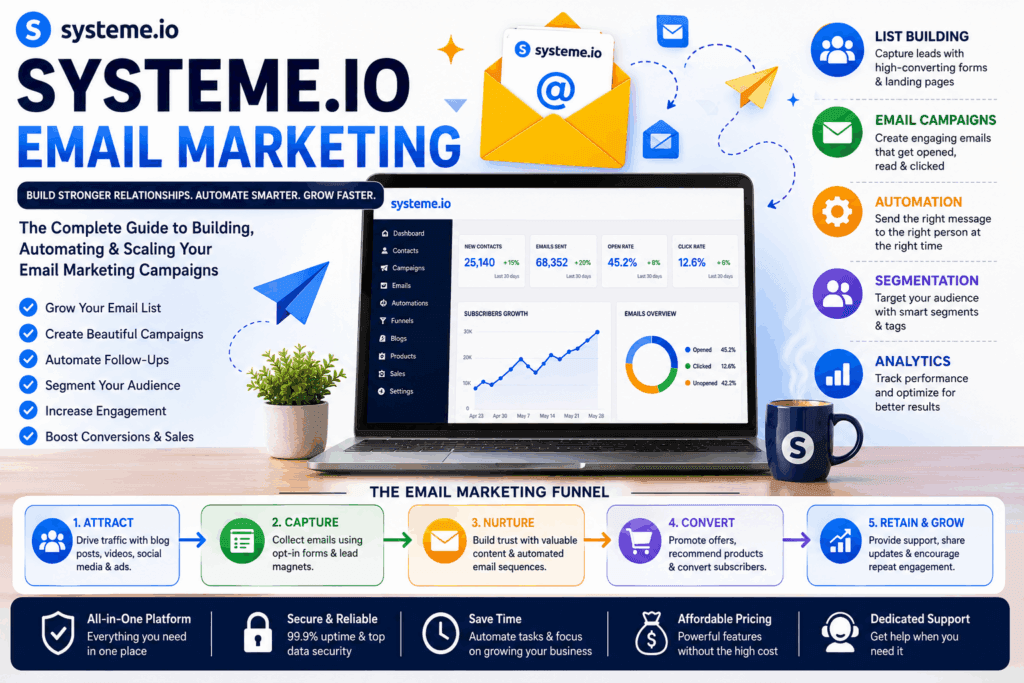
How Does Systeme.io Email Marketing Work?
A typical Systeme.io email marketing workflow can be divided into six stages:
1. Attract Visitors
Use SEO, YouTube, social media, advertising, referrals, or other traffic sources.
2. Capture Leads
Send visitors to a landing page with a valuable offer.
3. Add Subscribers
Collect their email address through an opt-in form.
4. Nurture Subscribers
Send educational and relationship-building emails.
5. Promote an Offer
Introduce a relevant product, service, course, consultation, or affiliate offer.
6. Automate and Optimize
Use workflows and performance data to improve your system.
The result is a marketing funnel that can continue working after the initial visitor leaves your website.
Step 1: Define Your Email Marketing Goal
Before creating an email campaign, decide what you want your email marketing to accomplish.
Different businesses have different goals.
Your objective might be:
- Generate leads.
- Sell a digital product.
- Promote an affiliate product.
- Book consultations.
- Sell an online course.
- Increase webinar registrations.
- Drive traffic to your blog.
- Launch a new service.
- Build a personal brand.
- Increase repeat purchases.
Your goal determines your email strategy.
For example, a freelancer may focus on booking discovery calls, while an affiliate marketer may focus on educating subscribers and recommending relevant products.
Step 2: Choose Your Target Audience
Good email marketing starts with understanding the recipient.
Ask yourself:
Who am I trying to help?
Then identify:
- Their problems.
- Their goals.
- Their knowledge level.
- Their objections.
- Their purchasing behavior.
- The questions they frequently ask.
- The solutions they’re already using.
For example, if your audience consists of beginner freelancers, your emails could cover:
- How to create a portfolio.
- How to find clients.
- How to write proposals.
- How to price services.
- How to communicate with clients.
- How to use productivity tools.
- How to build a personal brand.
The more clearly you understand your audience, the easier it becomes to create relevant emails.
Step 3: Create a Lead Magnet
One of the best ways to grow an email list is to offer something valuable in exchange for an email address.
This is commonly called a lead magnet.
Examples include:
Free Ebook
“Complete Beginner’s Guide to Affiliate Marketing”
Checklist
“25 Things to Check Before Launching Your Website”
Template
“Freelancing Proposal Template”
Resource Guide
“50 Essential Tools for Digital Marketers”
Mini-Course
“5-Day Email Marketing Bootcamp”
Case Study
“How I Built a Lead Generation Funnel Step by Step”
Webinar
“How to Build Your First Sales Funnel”
The lead magnet should be closely related to your main product or service.
If your lead magnet attracts the wrong audience, you’ll end up with a large email list that produces little business value.
Step 4: Build a Landing Page
Once you’ve created your lead magnet, you need somewhere to promote it.
A landing page should have one primary goal.
For example:
Get the Free Email Marketing Guide
A simple landing page can include:
- Strong headline.
- Supporting description.
- Benefits.
- Lead magnet preview.
- Email form.
- Clear call-to-action.
- Trust elements.
- Privacy information where appropriate.
Avoid overwhelming visitors with too many links and competing calls-to-action.
The simpler the conversion path, the easier it is for visitors to understand what you want them to do.
Step 5: Create Your Email List
When someone submits your opt-in form, their information can be added to your subscriber database according to your configured funnel, form, and automation settings.
You can then organize subscribers based on their interests or actions.
For example:
New Subscriber
↓
Downloaded Email Marketing Guide
↓
Interested in Funnels
↓
Clicked Product Tutorial
↓
High-Intent Prospect
This information becomes increasingly valuable as your email marketing system grows.
Step 6: Send a Welcome Email
Your first email creates an important first impression.
A good welcome email should:
- Thank the subscriber.
- Deliver the promised resource.
- Explain what they can expect.
- Establish your voice.
- Provide immediate value.
- Encourage the next useful action.
For example:
Subject: Your Email Marketing Guide Is Here
Start with a short introduction.
Then provide the promised resource.
After that, explain what subscribers can expect from future emails.
You could finish with:
“Tomorrow, I’ll show you how to turn a new subscriber into a qualified prospect.”
This creates curiosity and encourages subscribers to continue reading.
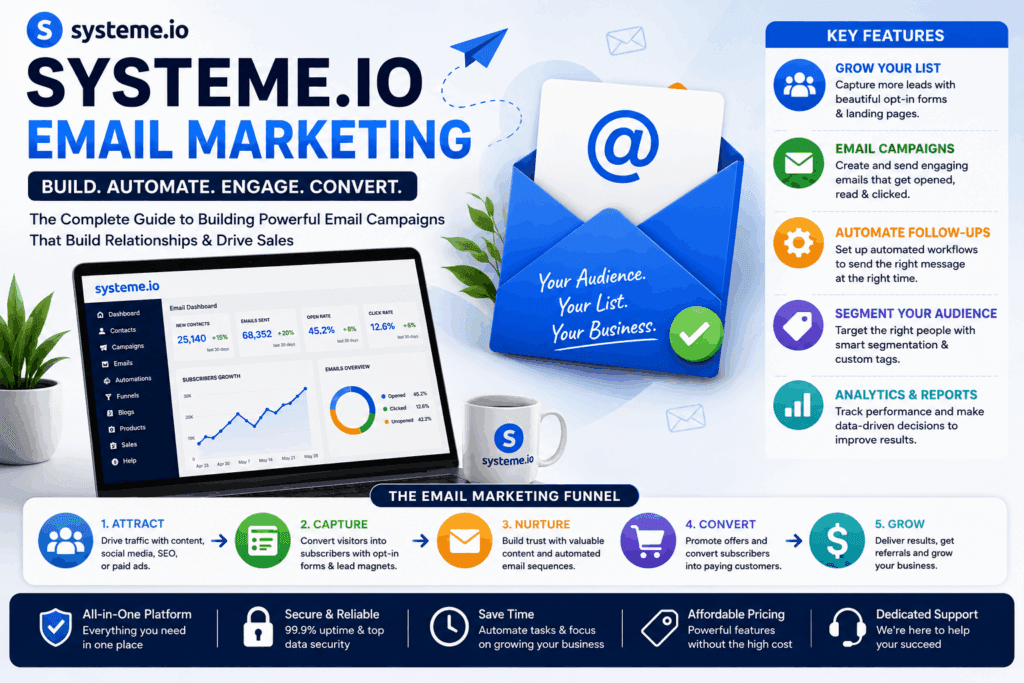
Systeme.io Email Campaigns
An email campaign is a planned series of messages designed to accomplish a specific objective.
For example, you could create a seven-email educational sequence.
Email 1: Welcome
Introduce yourself and deliver the lead magnet.
Email 2: Identify the Problem
Explain the biggest mistake your audience is making.
Email 3: Teach a Solution
Provide a practical strategy.
Email 4: Share a Case Study
Demonstrate the strategy in action.
Email 5: Introduce a Tool
Explain how a relevant product can help.
Email 6: Handle Objections
Answer common concerns.
Email 7: Call to Action
Invite subscribers to take the next step.
The exact sequence will depend on your business model and audience.
Systeme.io Email Automation
Automation is one of the most valuable components of email marketing.
Instead of manually sending every email to every subscriber, you can configure automated workflows based on subscriber actions.
A simplified workflow could be:
Visitor submits form
↓
Subscriber added to list
↓
Welcome email
↓
Wait
↓
Educational email
↓
Wait
↓
Case study
↓
Product recommendation
↓
Follow-up
This means a new subscriber can enter your marketing system at any time and receive the appropriate communication automatically.
Top, Middle, and Bottom Funnel Email Marketing
One of the best ways to structure your email strategy is by considering the three major stages of the marketing funnel.
Top of Funnel: Awareness
At this stage, the subscriber may not know you well.
Your goal is to:
- Educate.
- Build awareness.
- Establish credibility.
- Provide useful information.
Examples:
- Beginner guides.
- Industry tips.
- Educational videos.
- Blog posts.
- Free resources.
- Basic tutorials.
Email examples:
“5 Common Mistakes Beginners Make With Email Marketing”
“What Is a Sales Funnel?”
“How to Start Building an Online Audience”
Don’t aggressively sell at this stage.
Build trust first.
Middle of Funnel: Consideration
Now the subscriber understands their problem and is researching potential solutions.
Your goal is to help them evaluate options.
Content can include:
- Detailed tutorials.
- Case studies.
- Product comparisons.
- Reviews.
- Webinars.
- Expert insights.
- Frequently asked questions.
For example:
“Email Automation vs Manual Email Marketing: Which Is Better?”
or:
“How to Choose the Right Funnel Software for Your Business.”
At this stage, you can introduce relevant products and services naturally.
Bottom of Funnel: Conversion
The subscriber is now closer to taking action.
Your goal is to help them make an informed decision.
Content can include:
- Product demonstrations.
- Pricing explanations.
- Testimonials.
- Case studies.
- Benefits.
- FAQs.
- Risk-reduction information.
- Special offers where appropriate.
- Strong calls-to-action.
For example:
“How to Build Your First Automated Email Funnel”
could lead into a relevant product recommendation or service.
Email Segmentation
Not every subscriber has the same interests.
Sending the same email to everyone can reduce engagement.
Segmentation allows you to send more relevant messages.
You could segment subscribers based on:
- Interest.
- Lead magnet.
- Purchase status.
- Funnel stage.
- Email engagement.
- Product interest.
- Website behavior.
- Previous interactions.
For example:
Segment A
Interested in affiliate marketing.
Segment B
Interested in freelancing.
Segment C
Interested in email marketing.
Segment D
Existing customers.
Each group can receive different content.
This can make your marketing communication more relevant and personalized.
How to Write Better Marketing Emails
An effective email doesn’t need to be extremely long.
It needs to be useful.
A basic structure is:
1. Subject Line
Create curiosity without misleading the subscriber.
2. Opening
Start with a problem, question, story, or observation.
3. Main Value
Teach something useful.
4. Example
Make the concept practical.
5. Call-to-Action
Tell the reader what to do next.
For example:
Read the full guide.
Watch the tutorial.
Download the checklist.
Book a consultation.
Explore the product.
Avoid giving readers too many competing CTAs.
Email Subject Line Examples
Here are some examples you can adapt:
- The email marketing mistake most beginners make
- Here’s how to build your first email funnel
- 5 ways to grow your email list
- Your free marketing guide is here
- Before you send your next email…
- How to automate your follow-up
- Are you making this funnel mistake?
- A simple email strategy for beginners
- How to turn subscribers into customers
- The 7-email sequence you should know
The subject line should accurately represent the email.
Avoid deceptive clickbait.
Email Marketing for Affiliate Marketing
Systeme.io email marketing can also support affiliate marketing.
For example:
Blog Article
↓
Free Guide
↓
Email Subscriber
↓
Educational Sequence
↓
Product Tutorial
↓
Affiliate Recommendation
↓
Commission
This approach is generally more effective than simply dropping affiliate links everywhere.
The objective should be to help the subscriber solve a problem.
If a product is genuinely useful for that problem, your recommendation becomes a natural part of the conversation.
Always follow the relevant affiliate program’s terms and applicable disclosure requirements.
Email Marketing for Freelancers
Freelancers can use email marketing to generate and nurture leads.
For example, a graphic designer could offer:
“Free Brand Design Checklist.”
After someone downloads it, the freelancer could send:
Email 1
Deliver the checklist.
Email 2
Explain common branding mistakes.
Email 3
Show a before-and-after case study.
Email 4
Share branding tips.
Email 5
Introduce the freelancer’s services.
Email 6
Answer common client questions.
Email 7
Invite the subscriber to request a consultation.
This creates a structured customer journey.
Email Marketing for Online Courses
Course creators can use email marketing throughout the entire customer lifecycle.
Before the purchase:
- Educational content.
- Free lessons.
- Case studies.
- Student success stories.
- FAQs.
During the launch:
- Course announcement.
- Curriculum overview.
- Benefits.
- Objection handling.
- Deadline reminders where applicable.
After purchase:
- Welcome message.
- Course access instructions.
- Lesson reminders.
- Progress encouragement.
- Additional resources.
- Upsell or cross-sell opportunities where relevant.
Email marketing can therefore support both acquisition and retention.
Email Marketing for Lead Generation
Businesses that sell high-value services can use email marketing to nurture prospects before a sales conversation.
For example:
Traffic
↓
Free Consultation Guide
↓
Email Signup
↓
Educational Sequence
↓
Case Study
↓
Service Explanation
↓
Call Booking
The prospect gets useful information before being asked to make a significant commitment.
This can help improve the quality of leads entering the sales process.
How to Improve Email Open Rates
Open rates can vary significantly depending on audience, industry, device, sender reputation, privacy protections, and measurement methodology.
Instead of obsessing over one metric, focus on improving overall engagement.
Here are some practical approaches:
Write Relevant Subject Lines
Tell readers what they’ll get.
Build Recognition
Use a consistent sender name.
Segment Your Audience
Send more relevant messages.
Avoid Excessive Promotional Emails
If every email is a sales pitch, subscribers may stop paying attention.
Provide Consistent Value
Give people a reason to continue opening your messages.
Test Different Approaches
Compare subject-line styles, email formats, content topics, and calls-to-action.
How to Improve Click-Through Rates
Getting someone to open an email is only the first step.
You also need them to take action.
To improve clicks:
- Use one primary CTA.
- Make the benefit clear.
- Keep the email focused.
- Use descriptive link text.
- Match the email with the landing page.
- Avoid unnecessary distractions.
- Make sure the destination works properly.
- Test your email on mobile devices.
For example, instead of:
Click here
try:
Download the Free Funnel Checklist
The second CTA communicates the benefit more clearly.
Email Deliverability Best Practices
Deliverability is critical.
If your emails don’t reach the inbox, your content cannot perform.
Follow responsible email marketing practices.
Obtain Proper Consent
Only email people in accordance with applicable laws and the consent expectations of your audience and jurisdiction.
Don’t Purchase Email Lists
Purchased lists can damage sender reputation and create compliance problems.
Provide Unsubscribe Options
Subscribers should have a clear way to stop receiving marketing emails.
Keep Your List Healthy
Monitor inactive and invalid addresses.
Avoid Spammy Content
Don’t use deceptive subject lines or misleading claims.
Authenticate Your Sending Domain
Configure the appropriate email authentication records for your domain and sending setup.
This can include technologies such as SPF, DKIM, and DMARC where applicable.
Systeme.io Email Marketing Automation Examples
Here are several useful automation ideas.
New Subscriber Automation
Trigger: New opt-in
Action:
- Send welcome email.
- Deliver lead magnet.
- Start educational campaign.
Webinar Registration Automation
Trigger: Webinar registration
Action:
- Send confirmation.
- Send reminder.
- Deliver webinar.
- Follow up after the event.
Customer Automation
Trigger: Purchase
Action:
- Send thank-you email.
- Provide access information.
- Send onboarding instructions.
- Recommend relevant next steps.
Lead Nurturing Automation
Trigger: New lead
Action:
- Educational email.
- Case study.
- FAQ.
- Product explanation.
- CTA.
Common Systeme.io Email Marketing Mistakes
Mistake 1: Buying Email Lists
This can result in poor engagement, complaints, invalid addresses, and compliance problems.
Build your list legitimately.
Mistake 2: Sending Too Many Emails
More emails don’t necessarily mean more revenue.
Quality and relevance matter.
Mistake 3: Sending Only Promotional Emails
Your audience isn’t a list of wallets.
Teach, educate, entertain where appropriate, and help before selling.
Mistake 4: Ignoring Mobile Users
Many people read email on smartphones.
Your messages should be easy to read on smaller screens.
Mistake 5: No Clear CTA
If readers don’t know what to do next, your email may fail to generate action.
Mistake 6: Writing for Everyone
A highly generic email often feels irrelevant.
Write for a specific audience and specific problem.
Mistake 7: No Testing
Don’t assume your first version is your best version.
Test subject lines, CTAs, content formats, and landing pages.
Pros and Cons of Systeme.io Email Marketing
Pros
1. All-in-One Platform
Systeme.io brings multiple online marketing functions together, potentially reducing the need to manage numerous separate platforms.
2. Email Automation
Automated sequences can help marketers nurture leads without manually sending every message.
3. Funnel Integration
Email marketing can be connected with landing pages and funnels as part of a broader customer journey.
4. Useful for Beginners
Having multiple marketing functions within one platform can make the initial setup easier for beginners.
5. Lead Nurturing
You can create structured campaigns to educate prospects over time.
6. Suitable for Different Business Models
Email marketing can support freelancers, agencies, coaches, course creators, bloggers, affiliate marketers, and other online businesses.
7. Automation Saves Time
Once properly configured, recurring communication can happen automatically.
8. Centralized Marketing Workflow
Managing several connected marketing tasks in one environment can simplify day-to-day operations.
Cons
1. Learning Curve
Although an all-in-one platform can simplify your technology stack, you still need to learn funnels, campaigns, automation, segmentation, and email strategy.
2. Email Marketing Still Requires Strategy
Software cannot compensate for weak messaging, poor offers, or an irrelevant audience.
3. Deliverability Is Not Guaranteed
Your email practices, domain reputation, list quality, authentication, content, and subscriber engagement all matter.
4. Platform Dependency
Relying heavily on one platform means changes to features, policies, pricing, or availability can affect your workflow.
5. Advanced Users May Want Specialized Tools
Large organizations or highly technical marketing teams may require specialized tools and integrations beyond an all-in-one platform.
6. List Growth Takes Time
Email software doesn’t automatically create subscribers. You still need valuable content and effective traffic-generation strategies.
How Much Does Email Marketing Cost?
The cost of an email marketing strategy depends on your business model, list size, traffic sources, content creation, advertising, domain, and software requirements.
Don’t evaluate email marketing only by software cost.
Think about the entire system:
Traffic Cost + Content Cost + Software Cost + Time + Conversion Rate = Marketing Economics
For example, if you generate leads through SEO, your direct acquisition cost may differ from paid advertising.
Similarly, an email campaign that generates $5,000 in sales shouldn’t be judged only by the monthly software subscription. You should consider the total cost of acquiring and nurturing those customers.
Always verify the current Systeme.io pricing and plan limits directly from the platform before making purchasing decisions because software pricing and features can change.
A Practical 90-Day Systeme.io Email Marketing Strategy
Days 1–30: Build the Foundation
During the first month:
- Define your audience.
- Choose a specific marketing goal.
- Create a lead magnet.
- Build a landing page.
- Create an opt-in form.
- Set up your email list.
- Write your welcome email.
- Create a basic automated sequence.
- Publish useful content.
The goal is not perfection.
The goal is to get your first working system online.
Days 31–60: Grow Your Audience
During the second month:
- Publish SEO content.
- Create YouTube videos.
- Share educational social content.
- Promote your lead magnet.
- Improve your landing page.
- Expand your email sequence.
- Segment subscribers where useful.
- Test different CTAs.
At this stage, focus on generating qualified subscribers rather than simply increasing subscriber numbers.
Days 61–90: Optimize and Scale
During the third month:
- Review email engagement.
- Identify your best content.
- Improve weak emails.
- Test subject lines.
- Test CTAs.
- Improve landing-page conversion.
- Segment high-intent subscribers.
- Create additional lead magnets.
- Develop product-specific campaigns.
- Remove invalid or persistently inactive contacts where appropriate.
Optimization should become an ongoing process.
Important Email Marketing Metrics
You can’t improve what you don’t measure.
Some useful metrics include:
List Growth Rate
How quickly your email list is growing.
Open Rate
A measure of email opens, although modern privacy features mean this metric isn’t a perfect indicator of human engagement.
Click-Through Rate
Shows how frequently recipients click links or CTAs.
Conversion Rate
Measures how many recipients complete the desired action.
Unsubscribe Rate
Shows how frequently people opt out.
Bounce Rate
Shows the percentage of messages that cannot be delivered.
Revenue Per Subscriber
Useful for understanding the economic value of your list.
Don’t evaluate a campaign using one metric alone.
For example, an email with fewer opens can still generate more revenue if the people who engage are highly qualified.
How to Build a Long-Term Email Marketing Strategy
The best email marketing systems aren’t built around constant selling.
They are built around relationships.
A strong long-term strategy can follow this pattern:
Attract → Capture → Educate → Nurture → Recommend → Convert → Retain
Your content should help subscribers move naturally through these stages.
For example:
Attract
Create useful blog posts and videos.
Capture
Offer a relevant lead magnet.
Educate
Send valuable information.
Nurture
Share case studies and practical strategies.
Recommend
Introduce relevant solutions.
Convert
Use a clear CTA.
Retain
Continue providing value after the purchase.
This approach turns email marketing into a long-term business asset rather than a series of disconnected promotional campaigns.
Best Practices for Systeme.io Email Marketing
Follow these principles when building your system:
- Know your audience.
- Create a valuable lead magnet.
- Build a focused landing page.
- Set clear expectations after signup.
- Send a useful welcome email.
- Create automated sequences.
- Segment subscribers when it improves relevance.
- Balance educational and promotional content.
- Use strong but honest calls-to-action.
- Test different approaches.
- Monitor deliverability.
- Respect unsubscribe requests.
- Follow applicable email marketing laws.
- Avoid misleading claims.
- Keep improving your funnel.
Is Systeme.io Good for Email Marketing?
Systeme.io can be a useful option for marketers who want email marketing integrated with funnels, landing pages, automation, and other online-business tools.
Its main attraction is the ability to manage multiple parts of the customer journey in one platform.
However, the platform itself is not the strategy.
Your results depend on:
- Audience quality.
- Lead magnet quality.
- Email copy.
- Traffic.
- Offer.
- Segmentation.
- Automation.
- Deliverability.
- Consistency.
- Conversion optimization.
If you build a sophisticated automation system but send poor content to an irrelevant audience, the technology won’t solve the underlying problem.
On the other hand, a simple system with the right audience and useful content can perform remarkably well.
Systeme.io Email Marketing vs Traditional Email Tools
Traditional email marketing setups may require separate tools for:
- Landing pages.
- Email campaigns.
- Automation.
- Funnels.
- Website hosting.
- Course delivery.
- Payment processing.
- Customer management.
An all-in-one platform can reduce the number of systems that need to communicate with one another.
This can be particularly attractive to beginners and small businesses.
However, specialized platforms can sometimes provide deeper functionality for a particular use case.
The best solution depends on your needs.
If simplicity and centralized management are priorities, an integrated platform can be appealing.
If you have highly advanced enterprise requirements, you may prefer a more specialized technology stack.
Frequently Asked Questions
1. What is Systeme.io email marketing?
Systeme.io email marketing is the use of Systeme.io’s email campaigns, subscriber management, automation, and related funnel capabilities to communicate with leads and customers.
2. Is Systeme.io good for beginners?
It can be suitable for beginners because multiple online marketing functions are available within one platform. However, beginners still need to learn email marketing fundamentals, funnels, copywriting, segmentation, and deliverability.
3. Can I automate emails with Systeme.io?
Yes. Email automation is a major component of the platform’s marketing functionality. You can build workflows that respond to subscriber actions and other configured triggers.
4. Can I build an email funnel with Systeme.io?
Yes. You can combine landing pages, opt-in forms, email sequences, and automation to create an email-based marketing funnel.
5. What should I send to new email subscribers?
Start by delivering whatever you promised during signup. Then provide educational content, useful resources, practical tips, case studies, and relevant offers.
6. How often should I send marketing emails?
There is no universal frequency. Your schedule should depend on your audience, business model, content quality, and engagement. Consistency and relevance are generally more important than sending emails as frequently as possible.
7. Can I use Systeme.io for affiliate email marketing?
It can be used to support an affiliate marketing funnel, provided your marketing activities comply with the relevant affiliate program rules, email laws, platform policies, and disclosure requirements.
8. Can freelancers use Systeme.io email marketing?
Yes. Freelancers can use email marketing to capture prospects, nurture leads, demonstrate expertise, promote services, and encourage consultation bookings.
9. What is a lead magnet?
A lead magnet is a useful free resource offered in exchange for a visitor’s contact information, usually an email address.
10. What is an email sequence?
An email sequence is a series of planned messages delivered according to a schedule or subscriber behavior.
11. What is email segmentation?
Email segmentation means dividing subscribers into groups based on relevant characteristics or actions so that you can deliver more targeted communication.
12. How can I improve email conversions?
Improve the complete customer journey. Use a relevant lead magnet, clear landing page, useful emails, compelling but truthful messaging, relevant offers, strong CTAs, and continuous testing.
13. Should every email contain an affiliate link?
No. Constant promotion can reduce trust and engagement. A healthy strategy usually combines educational content with carefully selected promotional messages.
14. Can email marketing generate passive income?
Automation can reduce repetitive work, but email marketing isn’t completely passive. Successful systems require ongoing content creation, monitoring, testing, list management, and optimization.
15. Do I need a large email list to make money?
Not necessarily. A smaller, highly relevant and engaged audience can be more valuable than a large list of people who have little interest in your offer.
16. Is email marketing still effective?
Yes, but effectiveness depends on execution. Good email marketing focuses on relevance, permission, useful content, clear messaging, deliverability, and the needs of subscribers.
17. What is the biggest mistake in email marketing?
One of the biggest mistakes is treating subscribers only as potential buyers. Build trust and provide value before repeatedly asking for a purchase.
Also Read:
Google Ads for Small Businesses: Complete Guide for Veterinary Clinics and VET Doctors
Final Conclusion
Systeme.io email marketing can provide a structured way to build an audience, capture leads, nurture prospects, automate communication, and guide subscribers toward a desired action.
The most important thing to remember is that successful email marketing isn’t about sending more emails.
It’s about sending the right message to the right person at the right stage of the customer journey.
A powerful system can be as simple as:
Create Valuable Content → Capture Leads → Welcome Subscribers → Educate → Nurture → Recommend → Convert → Retain
Start with one audience, one lead magnet, one landing page, and one useful email sequence.
Once the foundation is working, add segmentation, advanced automation, additional lead magnets, new campaigns, and conversion optimization.
Don’t focus only on growing your subscriber count.
Focus on building an audience that trusts you.
Don’t focus only on email opens.
Focus on meaningful engagement and business outcomes.
And don’t treat automation as a replacement for strategy.
Use automation to deliver a better experience consistently.
When combined with valuable content, a relevant offer, responsible list-building practices, and continuous optimization, Systeme.io email marketing can become an important part of a broader digital marketing system. For more details.
